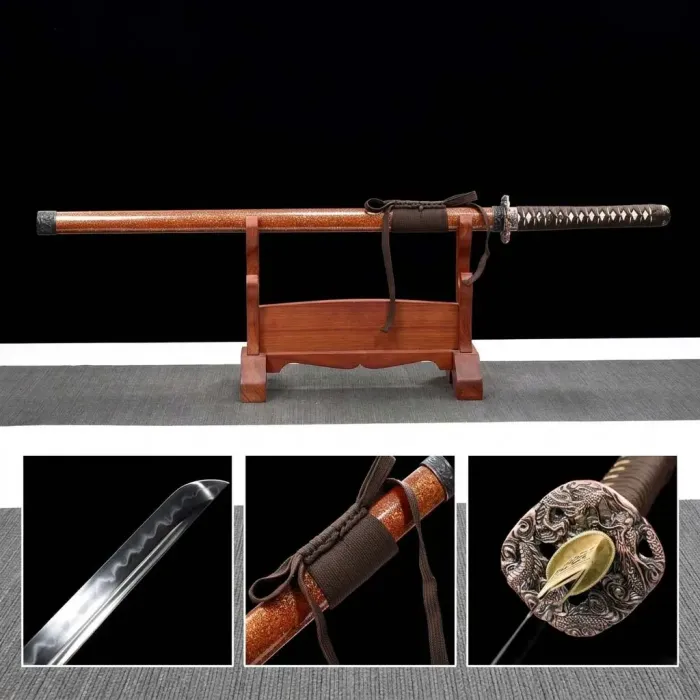
The classic Japanese sword exists as a exquisite piece of craftsmanship, but say you need to manifest your distinct design? Modifying your instrument is a meaningful journey, allowing you to construct a truly one-of-a-kind piece. From the shaft wrapping and sheath to the tsuba design and tempering curve, each element offers a chance for bespoke design. This investigation delves into the sphere of katana refinements, providing details for both initiates and experienced enthusiasts pursuing to establish their mark on the time-honored art of the samurai.
Primary Authentic Workmanship
For beginners eager to embark on the fulfilling journey of Japanese swordsmanship , 1060 steel katanas deliver an prime entry point. This selected grade of structural steel achieves a ideal mix between budget-friendliness and performance . While not quite as hard as upper-echelon steels, 1060 grants a moderate level of sharpening , making it perfect for newcomers to acquire the foundations of blade preservation and appreciate the elegance of handcrafted Japanese weaponry. It’s a great choice for acquiring experience without the capital burden of more high-grade steels.
T Ten Alloy Sabers : Harmonizing Excellence and Value
Catering to devotees seeking an authentic armament experience without overwhelming the capital constraint , T10 fabrication katanas represent a inviting option. These cutlery offer a distinct improvement in sturdiness compared to substandard alternatives, exhibiting respectable edge retention and enough flexibility for fundamental slicing techniques. While not rivaling the superior characteristics of higher-grade steels like T100 or folded compound, T10 provides a admirable blend of effectiveness and economy , making them a favored choice for students and those on a limited funds.
Moving beyond the Cutting Surface : Tailoring Your Sword's Fittings and Grasp
Though the refined edge is undeniably the essential point of a katana, truly boosting its appeal lies in the meticulous customization of its features and haft . This procedure allows enthusiasts to present their exclusive preference . Consider the ample possibilities: menuki - decorative charms that contribute visual attraction ; the hamon casings – often finely fashioned ; the tsuka center itself, wrapped in traditional ito cord ; and the fusa butt cap , which can be constructed from various elements like valuables or tusk .
- Select subjects that connect with you.
- Evaluate with diverse composites .
- Highlight merit for a permanent consequence.
The Enchantment of the Katana: Past, Crafting, and Elements
An historical weapon bears a unparalleled allure, steeped in centuries of eastern history and practice . More than merely a tool of fighting , it's a figure of the warrior ethos – a fusion of dexterity and rule. Its evolution spanned various generations, with early cutting tools evolving into the elegant curvature and fatal edge we accept today. The craftsmanship involved is truly astounding , requiring ages of coaching to master . The process involves a involved folding of smelted iron , creating layers that augment the sword’s flexibility and cleaving ability. Several schools of manufacturing developed , each with their individual secrets and styles for achieving the finest proportion and crispness - a truly laborious pursuit.
- Initial Katana models
- The significance of the oriental sword in soldier culture
- Conventional processing methods
Selecting the Best Steel for Your Japanese Sword Project: 1060 vs. T10
Deciding on the suitable steel is remarkably important for any blade project, and the determination between 1060 and T10 can be difficult. 1060 is a widely used American alloy, offering a reasonable balance of durability and robustness, providing it quite easy to temper. However, T10, a originating from Japan steel, usually boasts superior wear resistance and can perhaps achieve a elevated end hardness, although it can be substantially complex to operate and requires exact heat tempering. Consider your skillset and desired goals: for a learner, 1060 may be a more straightforward basis, while the proficient smith might favor the additional details of T10.
- Manageability of Applying
- Abrasion
- Ultimate Toughness
Unlocking the Potential: Advanced Katana Customization Techniques
Becoming proficient in blade improvement extends far beyond basic grinding. Serious experts are now exploring advanced techniques to truly release a blade's hidden potential. This features intricate work with the temper line, utilizing specialized resources for differential heat treatment and carefully choosing the outline of the protector to optimize balance and performance. Beyond purely functional customizations, artisans are increasingly focused on producing unparalleled aesthetic splendor, through complex imprinting and layered finishes that truly transform a katana into a fine art.
Building a 1060 Sword from Basic Metal to Beauty
The journey commences with plain 1060 iron , a solid material far absent the beautiful katana it will mature into . Master bladesmiths execute a involved process of overlaying and molding the initial steel, repeatedly warming it and impacting it to remove impurities and develop katana a stable grain structure. This painstaking process, often stretching for weeks , builds the crucial solidity and give characteristic of a original Japanese sword . Continued heat manipulations , including accurate hardening and conditioning , are indispensable to achieve the intended symmetry of sharpness, robustness and beauty .- Stacking: Lowers impurities and establishes grain structure.
- Shaping: Designs the steel into the initial blade form.
- Hardening: Determines the final hardness and flexibility.
The Ongoing Allure of the Katana: Detailed Survey of Metal and Enhancement
Every classic katana endures a potent symbol signifying Japanese style , its draw far surpassing mere martial implements . Forged from distinctive steel and regularly featuring intricate ornaments , the way of creation itself is a celebrated art. Beyond the foundational craftsmanship, the ability to personalize a katana - from the temper line to the hilt wrapping and guard - grants for a authentically individual representation for both devotees and handlers alike. This mixture of legacy steelwork and boundless personalization effectuates the katana's continued prestige across the terra .