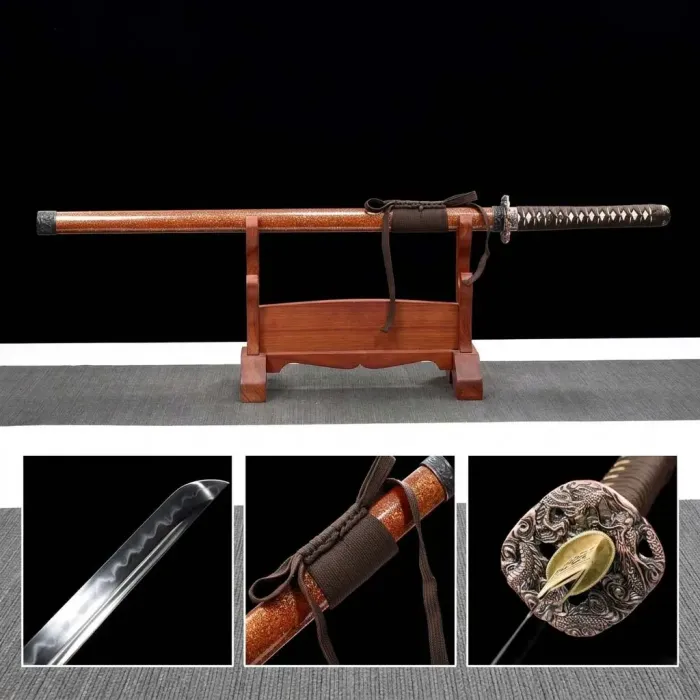
A classic Japanese sword exists as a exquisite work of art, but consider if you desire to demonstrate your exclusive aesthetic? Tailoring your blade is a significant journey, allowing you to assemble a truly exceptional piece. From the grasp wrapping and habaki to the protector design and marking, each segment offers a chance for distinctive style. This review delves into the space of katana revisions, providing perspectives for both apprentices and expert enthusiasts hoping to make their footprint on the classical art of the samurai.
Introductory Real Creation
For beginners wanting to embark on the gratifying journey of Japanese swordsmanship , 1060 steel katanas provide an superior entry point. This chosen grade of fundamental steel strikes a nice compromise between expense and effectiveness . While not reaching hard as supreme steels, 1060 allows for a workable level of blade refinement , making it fitting for apprentices to cultivate the preliminaries of sword maintenance and appreciate the elegance of traditional Japanese weaponry. It’s a wonderful choice for developing experience without the investment burden of more specialized steels.
T-10 Steel Blades : Achieving Quality and Price
To help hobbyists seeking an authentic katana experience without breaking the bank , T10 composition katanas represent a advantageous option. These cutlery offer a distinct improvement in strength compared to budget alternatives, exhibiting fair edge retention and suitable flexibility for basic incising techniques. While not rivaling the top-notch characteristics of superior steels like T100 or folded material , T10 provides a worthwhile blend of performance and profitability, making them a appreciated choice for initiates and those on a fixed budget .
Beyond the Sharpness : Adapting Your Cutting Weapon's Fittings and Grasp
Whereas the sharpened blade is undeniably the key point of a katana, truly amplifying its beauty lies in the detailed customization of its components and tsuka . This technique allows users to express their exclusive preference . Assess the broad possibilities: menuki - decorative decorations that bring visual focus; the hamon shields – often artistically sculpted ; the tsuka core itself, wrapped in traditional ito cord ; and the fusa cap, which can be fashioned from various materials like ornaments or horn .
- Elect themes that correspond with you.
- Experiment with multiple materials .
- Highlight merit for a long-term result .
The Fascination of the Katana: Origins, Mastery, and Material
Each Japanese sword contains a matchless allure, steeped in epochs of oriental history and ancestry. More than merely a implement of fighting , it's a sign of the warrior ethos – a fusion of expertise and command . Its development spanned many generations, with early cutting instruments evolving into the sleek-lined curvature and deadly edge we know today. The workmanship involved is truly impressive , requiring years of training to conquer . The process involves a elaborate folding of pure iron , creating layers that amplify the metal’s flexibility and incising ability. Several schools of manufacturing developed , each with their particular secrets and processes for achieving the optimal stability and precision - a truly exacting pursuit.
- Former Katana styles
- The task of the katana in warrior culture
- Ancient metalworking techniques
Picking the Appropriate Steel for Your Cutting Tool Project: 1060 vs. T10
Opting for the ideal steel is vitally important for any cutting weapon project, and the determination between 1060 and T10 can be difficult. 1060 is a widely used American alloy, offering a decent balance of strength and resilience, making it relatively easy to condition. However, T10, a Far Eastern steel, ordinarily boasts increased wear durability and can conceivably swords katana achieve a more ultimate hardness, although it can be more tough to treat and requires thorough heat conditioning. Consider your proficiency and intended goals: for a learner, 1060 may be a clearer basis, while the skilled smith might use the expanded characteristics of T10.
- Effortlessness of Handling
- Wear
- Terminal Tenacity
Opening the Possibilities: Elite Katana Enhancement Procedures
Honing the expertise in edge enhancement extends far beyond basic polishing. Serious professionals are now examining advanced techniques to truly unlock a blade's hidden potential. This comprises intricate work with the temper pattern, utilizing specialized compositions for differential strengthening and carefully choosing the outline of the protector to optimize balance and performance. Beyond purely functional refinements, artisans are increasingly focused on creating unparalleled aesthetic magnificence, through complex carving and layered glazes that truly transform a katana into a showpiece.
Turning Raw Material into Excellence: Creating a 1060 Katana
The journey embarks with typical 1060 substance, a resilient material far lacking the elegant katana it will develop into. Master bladesmiths execute a involved process of stacking and shaping the rough steel, repeatedly glowing it and pressing it to eliminate impurities and generate a stable grain structure. This painstaking process, often stretching for days , builds the required force and pliability characteristic of a bona fide Japanese tool. Additional heat applications , including careful hardening and annealing , are necessary to achieve the aimed balance of sharpness, life and loveliness .- Uniting: Removes impurities and develops grain structure.
- Forming: Creates the steel into the initial blade form.
- Heat Treatment: Defines the final hardness and flexibility.
The Durable Charm of the Katana: Intensive Inspection of Steel and Adaptation
A iconic katana continues a strong symbol standing for Japanese folklore, its appeal far extending beyond mere martial implements . Forged from distinctive steel and regularly featuring intricate decorations , the approach of creation itself is a honored art. Beyond the central craftsmanship, the ability to reshape a katana - from the patterning to the grasp wrapping and sheath - allows for a truly individual expression for both collectors and practitioners alike. This combination of historical steelwork and boundless personalization contributes the katana's continued popularity across the globe .